Currently Empty: ₹0
The subsidy on solar panel systems for Indian homes comes from the central PM Surya Ghar: Muft Bijli Yojana. It pays ₹30,000 per kW for the first 2 kW and ₹18,000 for the third kW, so any system of 3 kW or more earns the maximum of ₹78,000. To claim it, you register on the national portal, get your DISCOM’s approval, install through an empanelled vendor, get a net meter, and submit your bank details. The money reaches your account about 30 days after commissioning, and some states add their own top-up.
Most people do not struggle with the amount. They struggle with the order of the steps. Install before approval, pick a vendor who is not on the portal list, or buy modules that are not ALMM-listed, and your claim can be rejected. Websites also quote different state figures, and it is hard to tell which ones are current.
This guide covers what you can get, who qualifies, and the four steps to claim it. It comes from Truepower, a Delhi-based inverter manufacturer since 1993, so it also flags where your inverter choice matters.
What the subsidy pays and who qualifies
The central scheme pays a fixed amount per kW up to a 3 kW cap, and only for residential rooftop systems. Your state may add to it. Know both numbers before you ask any vendor for a quote.
What the central scheme pays
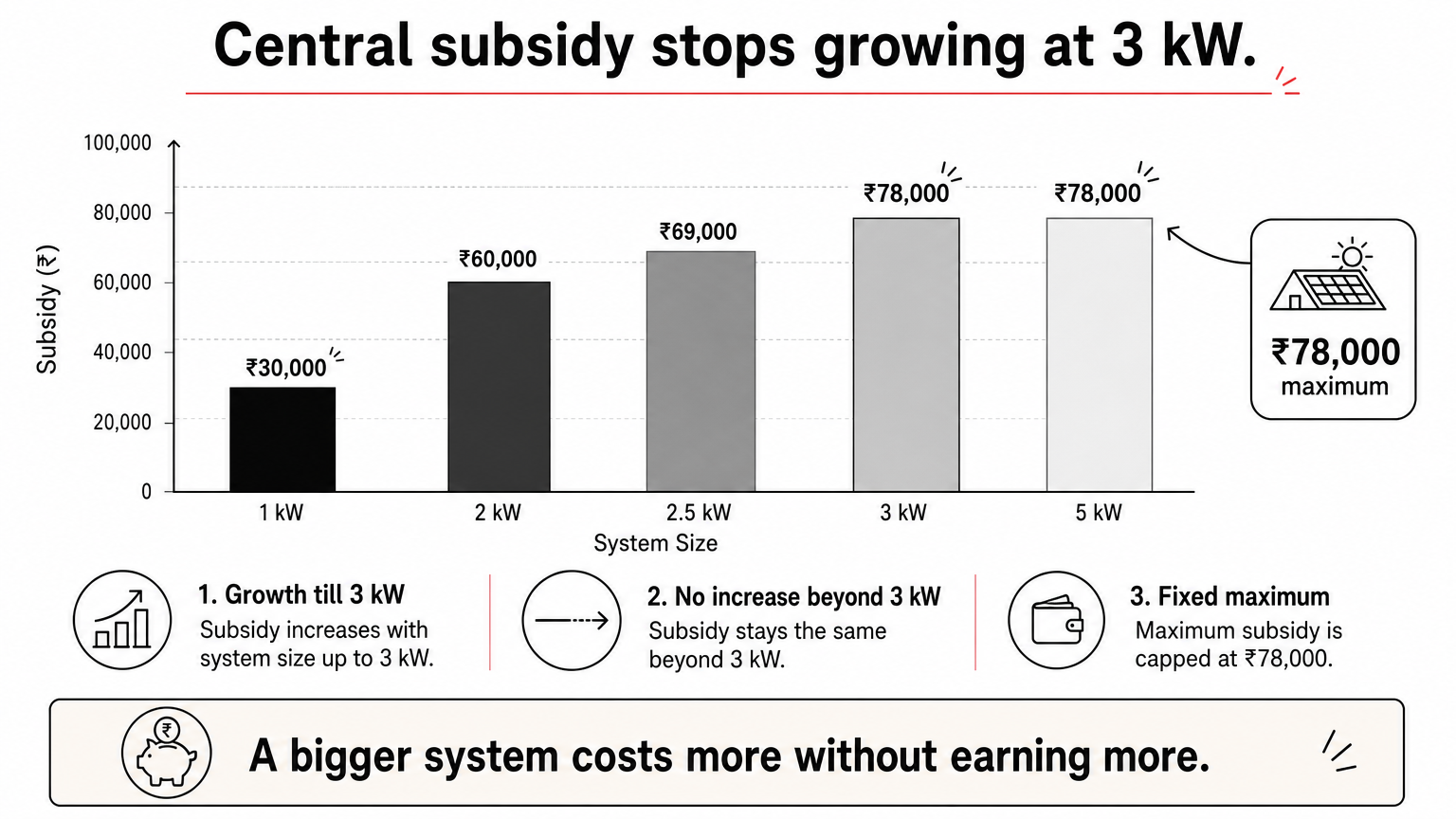
The subsidy is ₹30,000 per kW up to 2 kW and ₹18,000 per kW for the additional capacity up to 3 kW. It is calculated pro-rata, so a 2.5 kW system earns ₹60,000 plus ₹9,000.
| System size | Central subsidy |
|---|---|
| 1 kW | ₹30,000 |
| 2 kW | ₹60,000 |
| 2.5 kW | ₹69,000 |
| 3 kW | ₹78,000 |
| 5 kW | ₹78,000 (no extra above 3 kW) |
The central subsidy stops growing at 3 kW, so a bigger system costs more without earning more.
Who is eligible
You qualify for the solar panel subsidy when you meet these conditions:
- You are an Indian citizen who owns the house, with a roof that gets shade-free sunlight.
- You have a valid grid electricity connection, with the bill in your name.
- You have not taken another solar subsidy on the same connection.
- Your system is grid-connected with net metering. Off-grid battery systems do not qualify for the residential subsidy.
- Your modules are ALMM-listed and made in India, and a vendor from the portal’s empanelled list does the installation.
Tenants usually need a no-objection certificate from the owner. Housing societies can claim ₹18,000 per kW for shared-load systems up to 500 kW.
State top-ups
Several states pay on top of the central amount. The figures below were reported for 2026, but state schemes change often. Confirm the current amount with your state nodal agency or DISCOM before you rely on it.
| State | Reported top-up |
|---|---|
| Delhi | ₹10,000 per kW, max ₹30,000 |
| Uttar Pradesh | ₹15,000 per kW, max ₹30,000 |
| Bihar | ₹10,000 per kW, max ₹20,000 |
| West Bengal | ₹5,000 per kW, max ₹15,000 |
Step 1. Size your system and check your roof
Pick a capacity from your monthly electricity use, then confirm that your roof and paperwork are ready. Do this before you contact any vendor, so that you can judge their quotes.
Match capacity to your bill
Each kW of panels produces roughly 100 to 140 units a month. A household using 350 units a month needs about 3 kW, which is also the size that earns the full central subsidy.
Here is a worked example for a 3 kW system in Uttar Pradesh. Assume a quoted price of ₹2,00,000. The UPNEDA top-up is reported at ₹15,000 per kW, capped at ₹30,000, so a 3 kW system earns the full ₹30,000. Your quote and the current UPNEDA amount may differ, so treat this as an illustration.
| Item | Amount |
|---|---|
| Quoted system price | ₹2,00,000 |
| Central subsidy | ₹78,000 |
| Net cost with central subsidy | ₹1,22,000 |
| Uttar Pradesh top-up via UPNEDA (3 kW) | ₹30,000 |
| Net cost with central and UPNEDA top-up | ₹92,000 |
Size the system to your bill and the 3 kW cap, not to the biggest roof you have.
Check your roof and documents
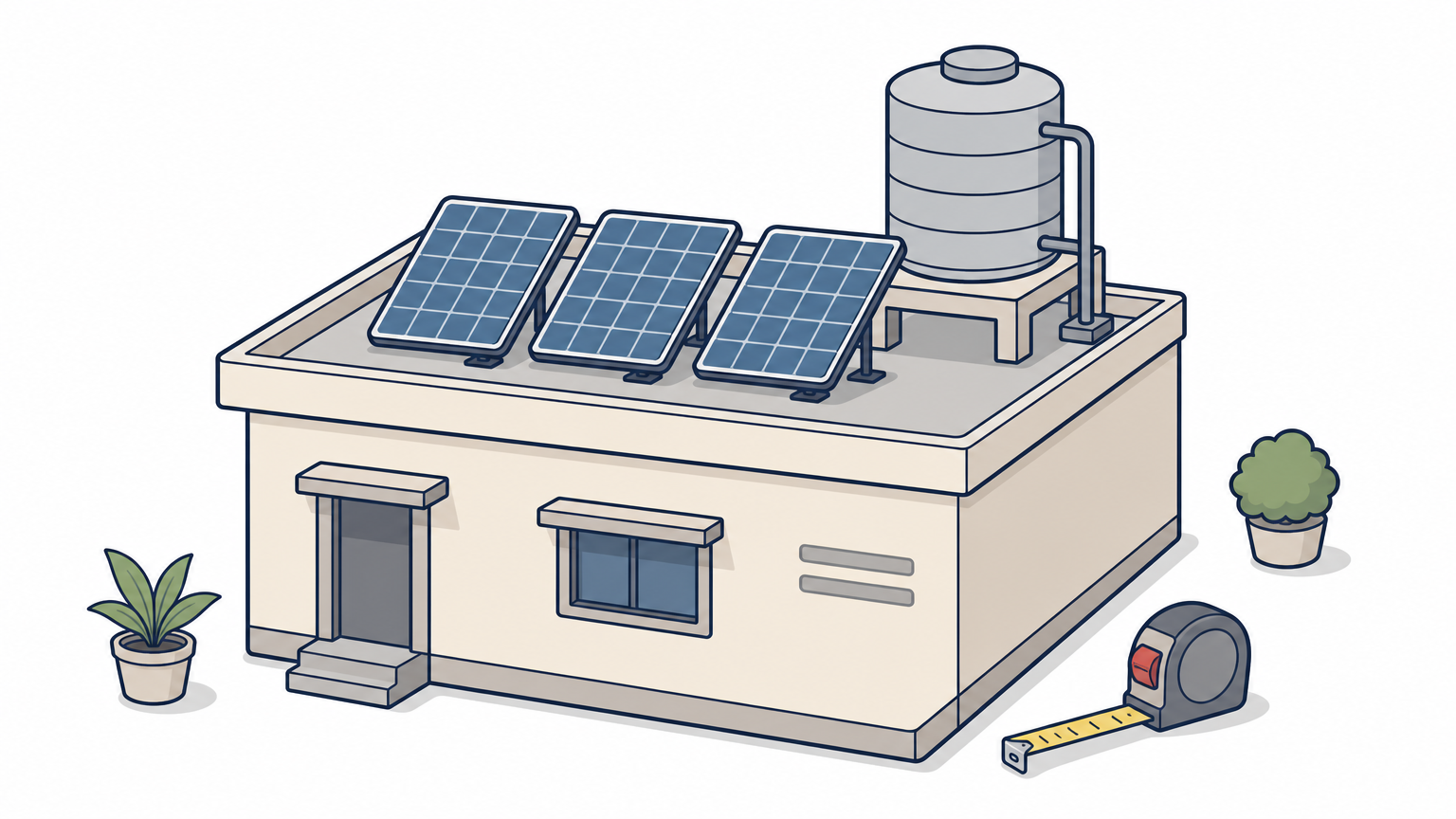
Plan on about 100 sq ft of shade-free roof per kW. Keep these ready:
- Latest electricity bill with your consumer number
- Aadhaar or other ID proof
- Property ownership proof, or a no-objection certificate if you rent
- Bank account details and a cancelled cheque
Step 2. Register and apply on the national portal
You apply for the subsidy online, and you must do it before you install anything. The whole process runs through the PM Surya Ghar national portal.
Register with your consumer number
- Open the portal and choose your state and electricity distribution company (DISCOM).
- Enter your electricity consumer number.
- Add your mobile number and email, and complete the verification.
- Log in and open the rooftop solar application.
Apply and wait for approval
Fill in your name, address and planned capacity in kW. Then select a vendor from the state-wise empanelled vendor list on the portal. Your DISCOM now checks technical feasibility, including transformer capacity.
Wait for the feasibility approval before you sign a final order or accept installation. Work that starts earlier can leave you without a valid claim.
Do not pay a vendor or start work until your DISCOM has approved feasibility.
Step 3. Install through an empanelled vendor
The vendor you chose installs the panels, inverter and mounting structure, and the equipment must meet the scheme’s standards. Check the three items below before you pay.
Check the equipment
Your solar panels must be ALMM-listed, and your inverter should be BIS-certified. For example, Truepower’s Kivo hybrid series holds BIS registration R-81022888. Ask your vendor to name the exact model and its certificate on your quote.
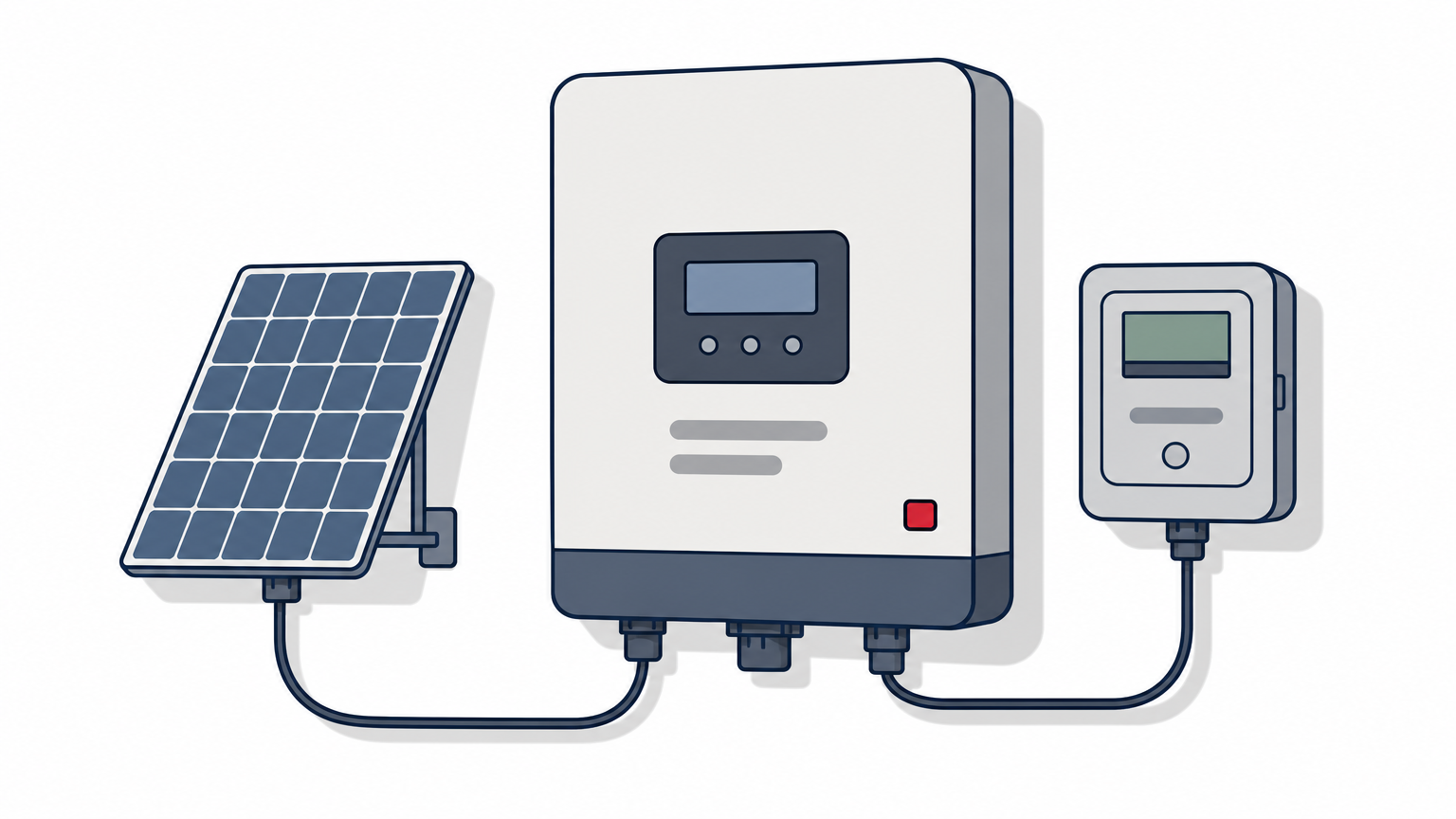
If you also want battery backup, ask the vendor in writing whether a hybrid configuration is accepted for subsidy in your DISCOM area. The subsidy is tied to a grid-connected, net-metered system. A hybrid inverter such as the Kivo can supply excess power to the grid, and it must be installed by a registered solar EPC vendor.
Kivo hybrid inverter: details for subsidy projects
The Kivo is Truepower’s hybrid solar inverter. It runs your home on solar, charges the battery, falls back to the grid, and supplies excess power to the grid for net metering. That grid export is what ties it to the grid-connected, net-metered system the subsidy requires. It holds BIS registration R-81022888.
| Model | Rated output | Max solar input | Battery voltage |
|---|---|---|---|
| Kivo Plus | 3.6 kW | 5,000 W | 24 V |
| Kivo Pro | 5.0 kW | 9,000 W | 24 V |
| Kivo Max | 6.5 kW | 9,000 W | 48 V |
| Kivo Ultra | 12.0 kW | 15,000 W | 48 V |
For distributor pricing on the Kivo range, get distributor prices from Truepower.
All four models have a built-in MPPT solar charger, pure sine wave output, and work with lithium or lead-acid batteries. For a 3 kW rooftop system, the Kivo Plus is the usual fit, since it takes up to 5,000 W of panels. A registered solar EPC vendor must install it. Before you order, ask your vendor to confirm in writing that your DISCOM accepts a hybrid inverter under the subsidy, and to list the Kivo model and its BIS certificate on the quote. See the full Kivo range for the complete specifications.
Pay and plan the cash flow
You normally pay the vendor first, and the subsidy comes back to your bank account after commissioning. Budget for the full price, not the post-subsidy price. If that is a stretch, banks offer collateral-free loans for rooftop solar under the scheme. SBI, for example, lists a Surya Ghar loan of up to ₹2 lakh.
You fund the full cost up front, and the subsidy refunds part of it later.
Step 4. Get the net meter and claim the subsidy
Once the system is installed, your DISCOM connects it and certifies it. Only then can you request payment of the subsidy on your solar panel system.
Net meter and commissioning
Submit your plant details on the portal and apply for a net meter. The DISCOM installs the meter, inspects the system and issues a commissioning certificate on the portal. Net metering is what lets surplus power go to the grid and reduces your bill.
Submit bank details and track payment
Upload your bank details and a cancelled cheque on the portal after commissioning. The central subsidy is usually credited within about 30 days of that submission. Track the status on the portal, and contact your DISCOM’s nodal officer if it stalls.
Apply for any state top-up through your state’s own process. It is often a separate application with its own rules and timeline.
Commissioning is the trigger. The subsidy moves only after the certificate and your bank details are in.
Check your numbers, then start the application
To get a subsidy on solar panels, size the system to about 3 kW, confirm your eligibility, apply on the portal, and install only after DISCOM approval. Use an empanelled vendor with ALMM-listed modules and a BIS-certified inverter. Then get the net meter, collect the commissioning certificate, and upload your bank details. Check your state’s top-up before you finalize the budget.
If you are a solar installer, dealer or distributor who needs BIS-certified hybrid inverters for subsidy-backed projects, get distributor prices from Truepower.