
Currently Empty: ₹0
PM Surya Ghar is the Government of India’s rooftop solar scheme, officially called PM Surya Ghar: Muft Bijli Yojana. It pays a central subsidy of up to ₹78,000 to households that install solar panels on their own roof. Launched in February 2024 with an outlay of ₹75,021 crore, it targets one crore homes. An eligible household can generate enough power to get up to 300 units of free electricity a month. You apply online on the national portal, pmsuryaghar.gov.in. You may also see the scheme written as PM Ghar Surya Yojana.
This guide covers what the scheme gives you, how the subsidy is calculated by system size, who qualifies, and the steps to apply online. It also shows how to size a system from your electricity bill and why claims get rejected. Rules are amended from time to time, so confirm the latest figures on the portal before you commit.
We are Truepower, an inverter manufacturer in Delhi since 1993. Many buyers ask us how the solar subsidy fits with an inverter and battery, so we have covered that part too.
Why the PM Surya Ghar scheme matters to your household
It matters because it removes the biggest barrier to rooftop solar, the upfront cost. It also gives you a clear way to cut your power bill for the next two decades or more.
What you get from the scheme
The central government pays Central Financial Assistance (CFA) on the solar capacity you install. Beyond the subsidy, eligible households can get collateral-free loans from nationalised banks at the repo rate plus 50 basis points, for up to 10 years. The rate moves with the repo rate, so ask your bank for the current figure.
Your system may also earn money. Subject to your state and DISCOM rules, you can export surplus electricity to the grid. States can add their own top-up subsidy over the central amount, and Delhi and Goa have done so. Check with your state renewable energy agency before you calculate your final cost.
The scheme pays for part of your system, finances the rest cheaply, and lets surplus power earn you money.
How much subsidy you get
The subsidy is ₹30,000 per kW for the first 2 kW and ₹18,000 for the third kW, capped at ₹78,000. Adding more capacity beyond 3 kW does not raise it. The table below sets your usual consumption against the system size and subsidy.
| Average monthly consumption | Suitable system size | Central subsidy |
|---|---|---|
| 0 to 150 units | 1 to 2 kW | ₹30,000 (1 kW) to ₹60,000 (2 kW) |
| 150 to 300 units | 2 to 3 kW | ₹60,000 (2 kW) to ₹78,000 (3 kW) |
| Above 300 units | Above 3 kW | ₹78,000 maximum |
How to apply for PM Surya Ghar online
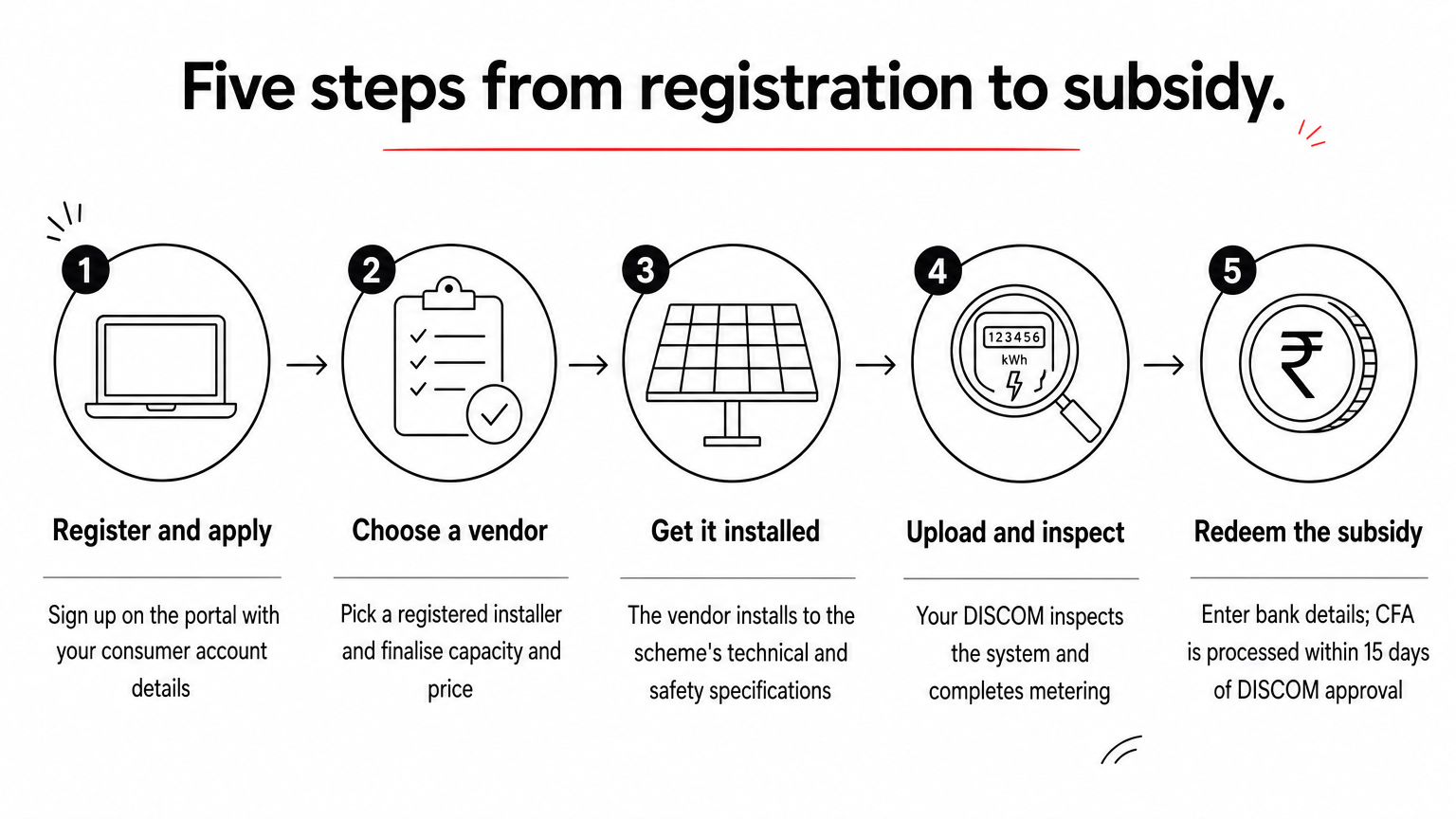
You apply through the national portal in five steps. A registered vendor and your DISCOM handle the installation and verification.
Eligibility and documents to keep ready
You qualify if you meet all of these conditions:
- You are an Indian citizen.
- You own a house with a roof suitable for solar panels.
- You have a valid grid-connected electricity connection with your local DISCOM.
- You have not already taken another government subsidy for rooftop solar.
- You complete Aadhaar authentication or provide proof of an Aadhaar number, as the current rules require.
Keep your electricity consumer account number, Aadhaar details and bank account proof ready. A cancelled cheque, passbook or e-statement works. After installation you will also need geo-tagged photographs and the metering paperwork.
The five steps from registration to subsidy
- Register and apply. Sign up on pmsuryaghar.gov.in with your consumer account details and submit the rooftop solar application. The portal generates your application ID.
- Choose a registered vendor. Pick an installer listed on the portal and finalise the capacity, components and price. For systems up to 10 kW, technical feasibility is deemed accepted, though some states may still apply their own requirements.
- Get the system installed. The vendor installs it to the scheme’s technical and safety specifications. The equipment must meet the Domestic Content Requirement.
- Upload details and pass inspection. The vendor uploads system details and photographs. Your DISCOM inspects the system and completes metering. The net-metering agreement is now part of the portal application.
- Redeem the subsidy. Enter your bank details on the portal. Current guidelines provide for the CFA to be processed within 15 days of DISCOM approval.
You can reach the scheme’s toll-free helpline on 15555 if you get stuck at any step.
Apply on the official portal yourself, because you do not need an agent to register.
How to size your PM Surya Ghar system and choose an inverter
Size the system from your actual consumption first, and pick the inverter and battery second. The subsidy follows panel capacity and nothing else.
Sizing from your electricity bill
Take your average monthly units from the last 12 months of bills. Say you use about 250 units a month. The table puts you in the 2 to 3 kW band. A 1 kW system commonly produces around 4 units a day in good sunlight, so 2 kW covers roughly 240 units a month on paper. Most households choose 3 kW to leave margin for seasons and future appliances. That earns the full ₹78,000 subsidy.
For illustration only, suppose your installer quotes ₹1,80,000 for 3 kW. Your cost after subsidy is ₹1,02,000, before any state top-up. Your own quote will differ, so compare at least two registered vendors.
Grid-tied, hybrid and battery options
The CFA is calculated only on solar module capacity, not on the cost of a battery. Grid-connected battery-hybrid systems can qualify subject to your state electricity regulator’s approval. Completely off-grid systems are not eligible. If power cuts are common where you live, a hybrid setup keeps your home running while the panels still earn the subsidy.
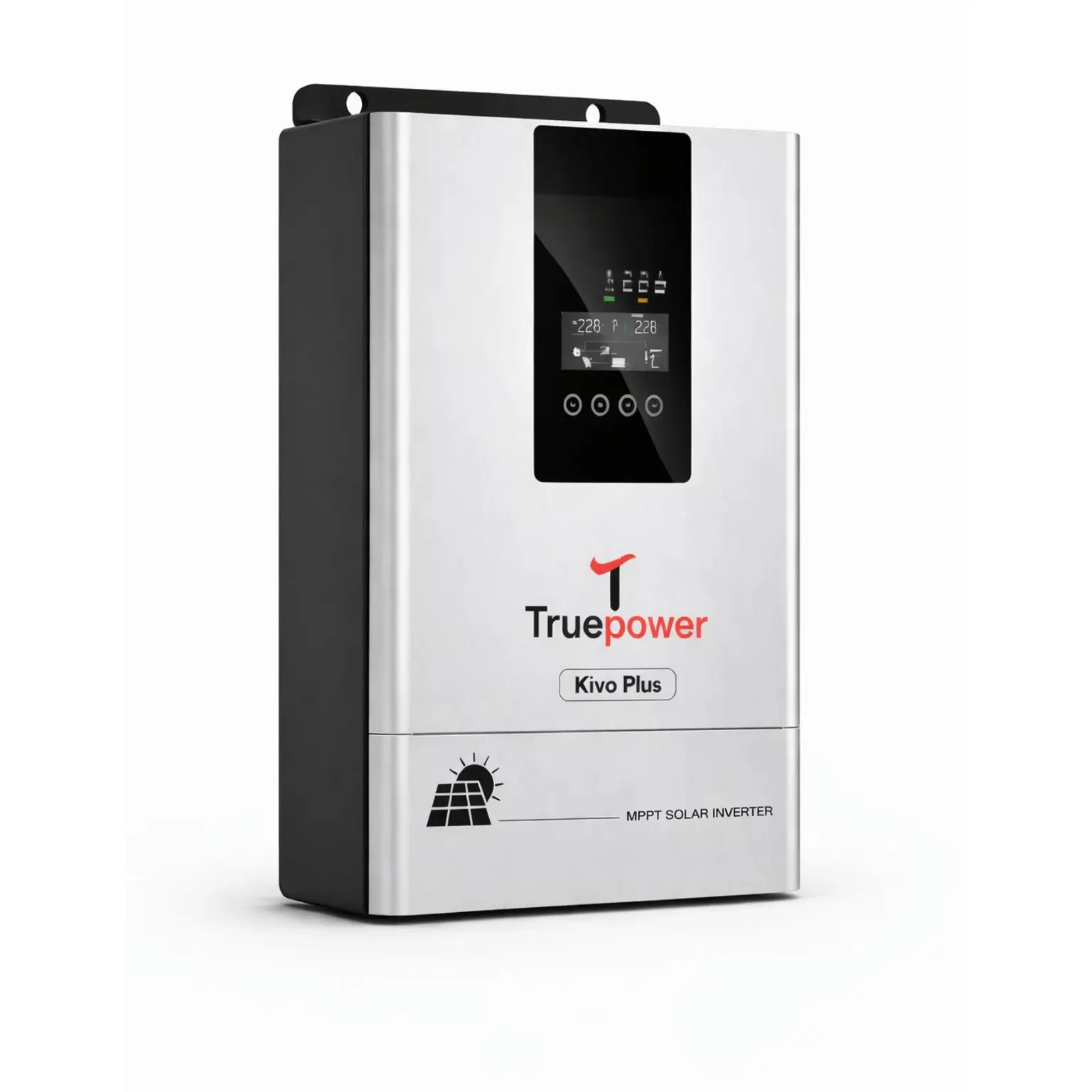
Our KIVO Hybrid Solar Inverter is built for this. It has a built-in MPPT solar charger and takes up to 5,000 W of panels on Kivo Plus, 9,000 W on Kivo Pro and Kivo Max, and 15,000 W on Kivo Ultra. It uses solar first, then the battery, then the grid, and it supplies excess power to the grid for net metering. Four models run 3.6 kW to 12 kW of load, priced from ₹73,000 to ₹2,78,000 for the inverter, with a lithium or lead-acid battery added separately. A registered solar EPC vendor should install it. Check with your installer that the full configuration meets your DISCOM’s requirements.
Size your panels from your bill, then choose the inverter and battery for the backup you need.
Why PM Surya Ghar claims get rejected, and how to avoid it
Most delays come from small mismatches in paperwork or from an installer who is not on the portal. You can prevent nearly all of them with a few checks before you submit.
Common causes of rejection
Watch for these six problems:

- Your name or details differ between electricity, identity and bank records.
- The vendor is not registered on the national portal.
- The equipment does not meet scheme requirements or the domestic content rule.
- Installation documents or geo-tagged photographs are missing or wrong.
- Your DISCOM finds errors during inspection or commissioning.
- Your bank details are incorrect, which delays payment of the CFA.
Match every document against your electricity bill before you upload it. Ask your vendor to show portal registration before you pay any advance.
Housing societies and timing
If you live in an apartment, Resident Welfare Associations and group housing societies can get CFA of ₹18,000 per kWp for common facilities such as EV charging. Support goes up to 500 kWp, with a limit of 3 kWp per house. The scheme is currently set to run through FY 2026-27, so do not leave your application until the last months.
A clean, matching set of documents and a registered vendor prevent most delays.
Your next step after reading about PM Surya Ghar
PM Surya Ghar gives you a clear path. Check your eligibility, size the system from your bills, apply on the portal, and use a registered vendor. The subsidy tops out at ₹78,000 for 3 kW, and cheap bank loans can cover the rest.
If you also want backup during power cuts, plan the inverter and battery alongside your panels. Send us your appliance list and the hours of backup you need. We will suggest a model and battery from our hybrid solar inverters.
1 Comment
[…] subsidy on solar panel systems for Indian homes comes from the central PM Surya Ghar: Muft Bijli Yojana. It pays ₹30,000 per kW for the first 2 kW and ₹18,000 for the third kW, so any system of 3 kW […]