
Currently Empty: ₹0
Installer or dealer selling inverter solar hybrid units? Get distributor prices from Truepower.
An inverter solar hybrid unit, more commonly called a hybrid solar inverter, is one device that connects your solar panels, a battery and the grid. It converts panel power for your appliances, stores spare energy in the battery, draws from the grid when both fall short, and can send surplus back through net metering. In India, Truepower’s Kivo range costs ₹73,000 to ₹2,78,000 for the end users. The battery and panels are extra.
Whether that price makes sense depends on your load, your outage pattern and your state’s net metering rules. This article explains why a hybrid inverter is worth considering, how to size and choose one with a worked example, what the full system costs, and what to check on installation and warranty.
Truepower has manufactured inverters in Delhi since 1993, and the Kivo hybrid series is built for Indian grid conditions such as voltage swings and long outages.
Why a hybrid solar inverter matters
A hybrid solar inverter matters because it fixes two problems with one purchase: a high electricity bill and an unreliable supply. A plain solar setup only helps with the bill. A plain inverter with a battery only helps with outages.
How it differs from on-grid and off-grid inverters
The difference is that the battery and the grid work together. An on-grid inverter shuts down when the grid fails, so your solar stops exactly when you need it. An off-grid inverter works without the grid but cannot export surplus power. A hybrid does both jobs.
| Feature | On-grid | Off-grid | Hybrid |
|---|---|---|---|
| Uses solar panels | Yes | Yes | Yes |
| Stores power in a battery | No | Yes | Yes |
| Runs during a power cut | No | Yes | Yes |
| Exports to the grid | Yes | No | Yes, where the model and state allow |
| Needs a grid connection | Yes | No | Optional |
A hybrid inverter keeps your solar working during a power cut, which an on-grid inverter cannot do.
Where the savings and backup come from
The saving comes from using solar power first. Daytime loads run directly from the panels and the surplus charges the battery. What happens after sunset is your choice, because a hybrid inverter lets you change which power source runs the home load first.
You can let the battery cover the evening, but it then charges and discharges every day. Most people use the battery as backup instead. If the battery is empty by night and the grid fails, nothing is left to run your home. So many buyers let the grid run the evening load and keep the battery full for outages. Kivo hybrid inverters support both setups, so you can configure the one that suits you.
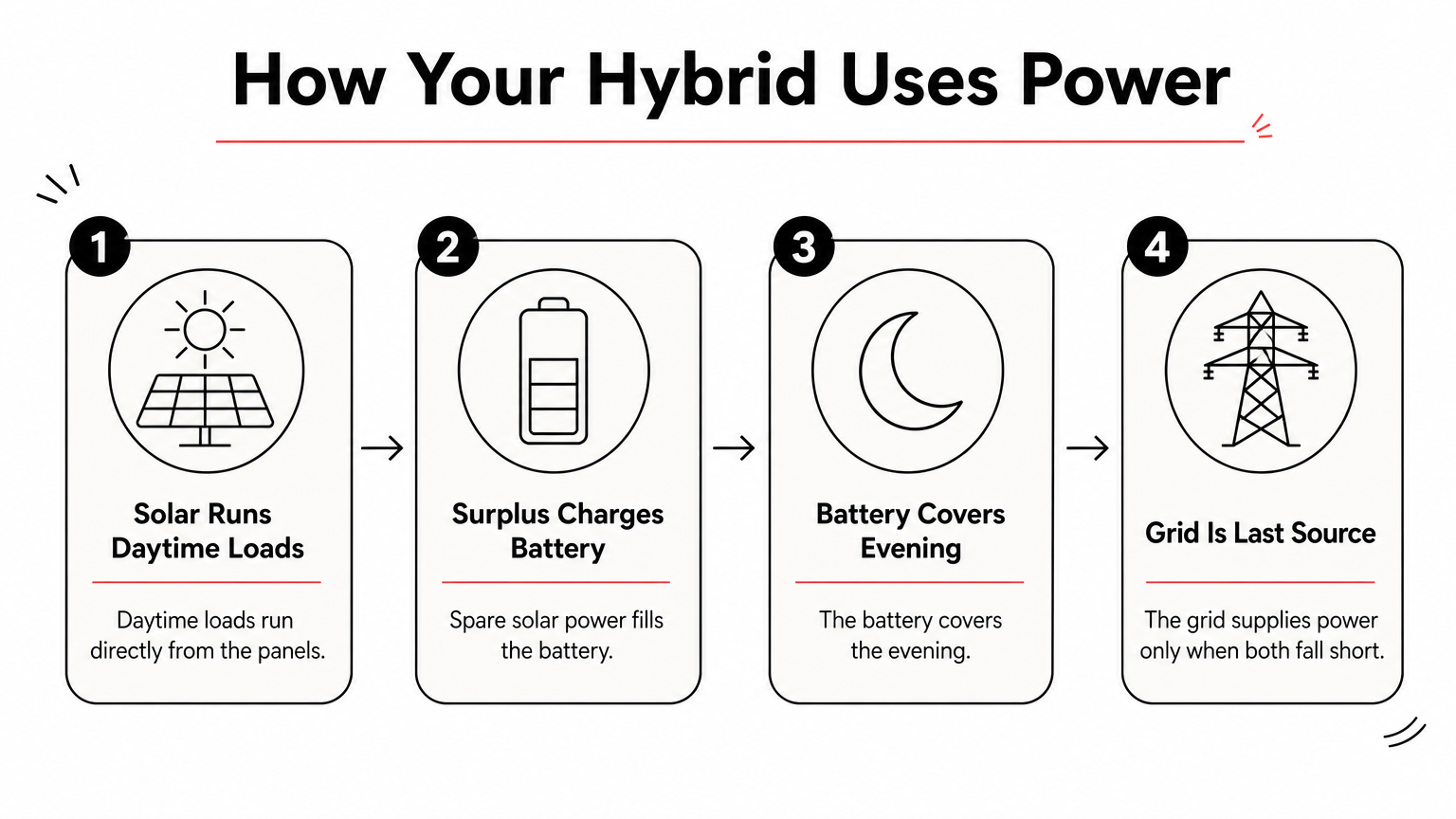
The backup comes from the battery, so its size sets how long you stay powered. When the grid drops, the inverter switches to solar and battery automatically. If your model and state allow it, surplus daytime power can go to the grid under net metering. Rules differ between state discoms, so confirm them before you pay for export capability.
How to choose a hybrid solar inverter
Choose a hybrid solar inverter by working backwards from your appliances: the inverter rating comes from your load, the battery from your backup hours, and the panel limit from your roof. The best hybrid solar inverter in India for you is the one that fits those three numbers, carries BIS certification and service issues can be easily resolved.
Size it from your load, not from the panels
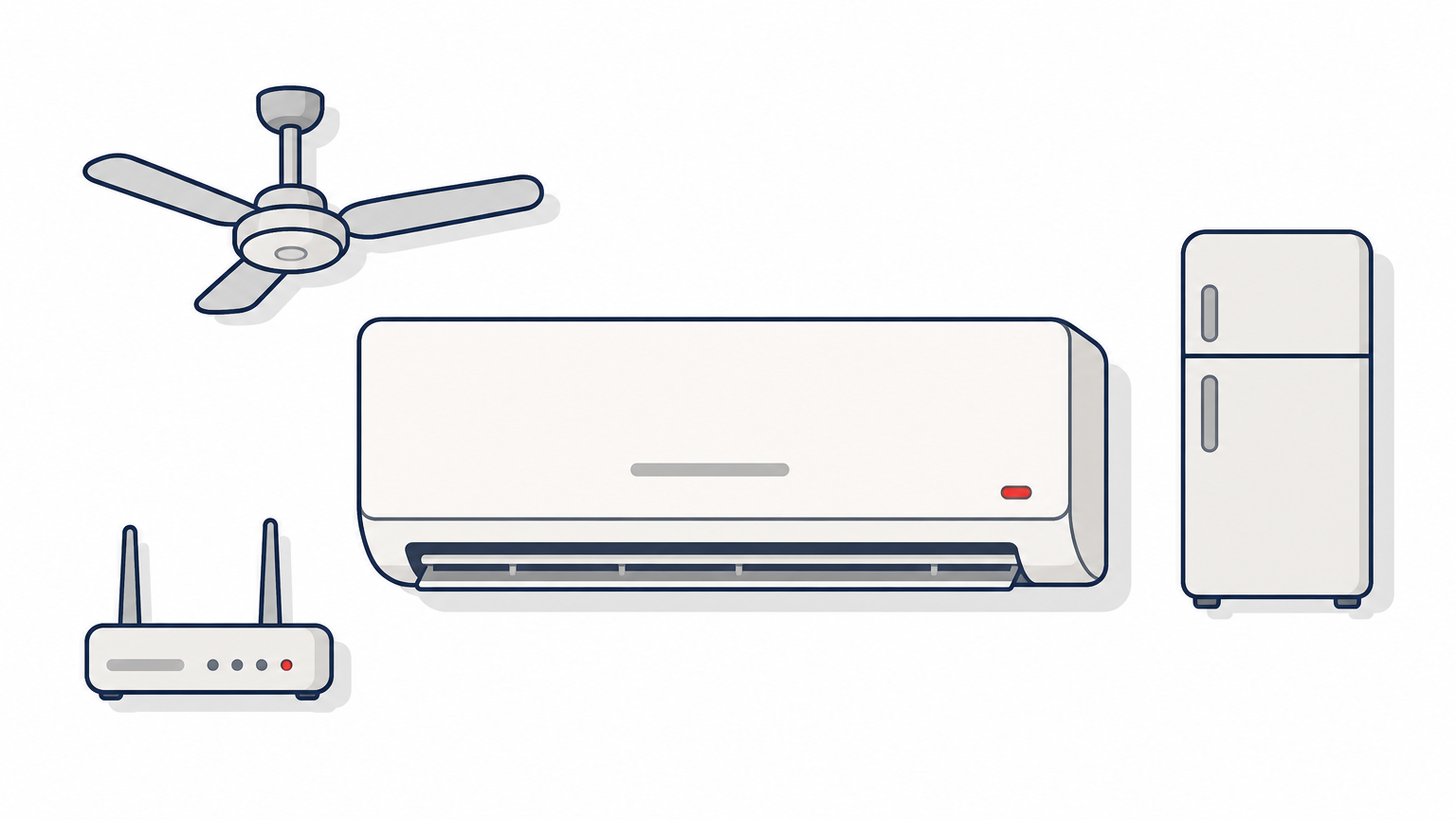
List what you want to run during a power cut and add the running watts. Take a typical home that wants to keep one inverter AC, a fridge, fans and basic electronics on.
| Appliance | Running load |
|---|---|
| 1.5-ton inverter AC | 1,400 W |
| Refrigerator | 250 W |
| 4 ceiling fans | 300 W |
| Lights, TV, Wi-Fi router | 250 W |
| Total | 2,200 W |
Add about 25% headroom for surge and ageing, which gives roughly 2,750 W. A 3.6 kW inverter, the smallest Kivo, covers this with room to spare. Motors and AC compressors draw several times their running load for a moment at start, so never size to the exact total.
For the battery, multiply watts by hours. Running all 2,200 W for one hour needs 2.2 kWh. A battery with 5 kWh of usable energy runs the full load for about 2.3 hours. It lasts much longer if you switch the AC off. Then check that the inverter’s maximum panel input is higher than the array you plan to install.
Features to check before you buy
Compare these on every spec sheet:
- MPPT solar input: the maximum panel wattage, the voltage range and the number of trackers. Kivo models take 5,000 W to 15,000 W of panels depending on the model.
- Battery support: the system voltage (Kivo uses 24V or 48V) and whether it accepts lithium, lead-acid or both. Higher loads generally suit 48V.
- Grid export: confirm the unit supports net metering, and that your DISCOM allows it.
- Phase: single-phase for most homes, three-phase for factories and large commercial sites.
- Protection and build: overload, short-circuit, over-voltage and overheat protection, and an IP rating suited to the place you install it.
- Expansion: parallel connection if your load may grow.
- Monitoring: an app or display that shows solar generation and battery health.
- Paperwork: BIS certification and a clear warranty period.
Size the inverter from your running load plus headroom, then size the battery from the hours of backup you need.
Hybrid solar inverter price in India
The price of a solar hybrid inverter in India depends mainly on capacity. Truepower’s Kivo hybrid solar inverter costs ₹73,000 to ₹2,78,000 across four models from 3.6 kW to 12 kW. That is the inverter only. The battery, panels and installation are separate, and you should ask any brand for a quote that lists them separately.
What moves the price
Capacity is the biggest factor, followed by the features below.
| Factor | Effect on price |
|---|---|
| Power rating (3.6 kW to 12 kW) | Larger units cost more |
| Solar input (more MPPT and higher panel limit) | Higher limits cost more |
| Single-phase or three-phase | Three-phase generally costs more |
| Battery compatibility and parallel support | More flexibility adds cost |
| Monitoring, IP rating, protections | Add to cost |
| Warranty length and service network | Longer cover and wider support add to cost |
Kivo models differ in solar input: Kivo Plus takes up to 5,000 W of panels, Kivo Pro and Kivo Max up to 9,000 W, and Kivo Ultra up to 15,000 W. The four models run at 3.6 kW, 5 kW, 6.5 kW and 12 kW.
What the full system costs beyond the inverter
Treat the inverter as one line of the budget. Ask for a quote that includes:
- the battery, lithium or lead-acid, sized to your backup hours
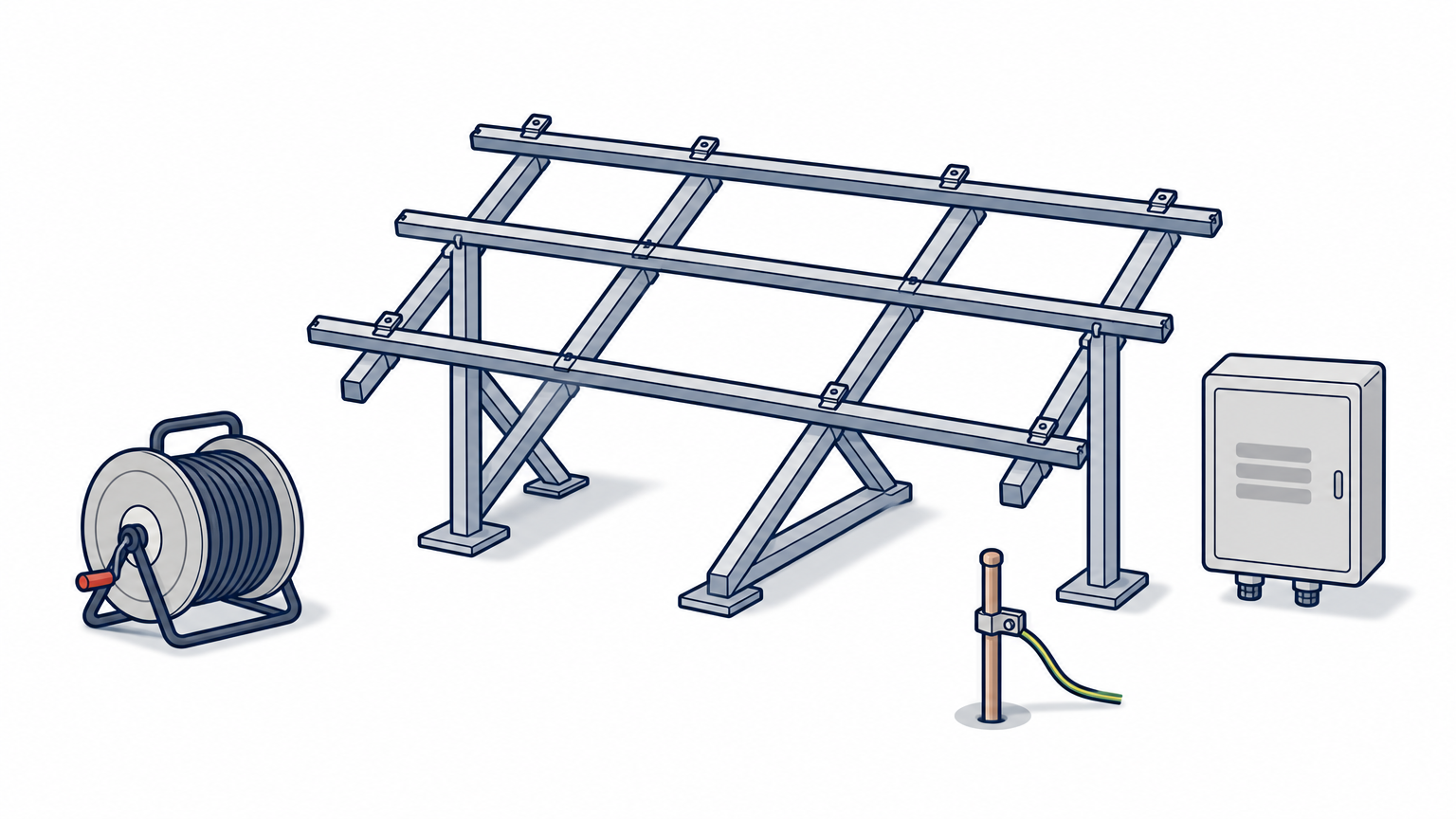
- the solar panels and mounting structure
- cabling, protection devices and earthing
- installation by a registered solar EPC company
- net metering paperwork, if you plan to export
Two quotes are only comparable when they cover the same inverter capacity, battery energy, panel wattage and warranty. A cheaper quote often leaves out the battery or the installation.
The inverter is only one line in the budget, so compare complete quotes with the same battery, panels and warranty.
Installation, warranty and mistakes to avoid
Have a registered solar EPC vendor install your hybrid inverter, because installation affects safety, performance and your warranty. Truepower’s warranty is void if the manual’s installation procedure is not followed, so a poor installation can cost you the cover.
Installation and warranty basics
A hybrid system is not plug and play, because it ties panels, battery and grid together. Truepower hybrid inverters in the Kivo series carry a 5 year warranty, depending on the model. To claim it, you need the original tax invoice and the unit’s serial number. Register the product through the Help Centre, or have an authorised dealer sign and stamp the warranty card.
Report transit damage or a dead-on-arrival unit within 24 hours of delivery, with a continuous, unedited unboxing video. The warranty also excludes damage from lightning, flooding and incorrect voltage input, so ask your installer about surge protection and earthing.
Mistakes that cost buyers money
- Sizing to the average load. Surge from an AC or pump trips undersized units.
- Buying export capability you cannot use. Check your state’s net metering rules first.
- Ignoring battery voltage. The battery bank must match the inverter’s system voltage.
- Skipping the site check. Even with a dust and splash rating such as IP54, place the unit in a shaded, ventilated spot.
- Comparing only the inverter price. A low price with no battery or installation is not a low total.
A hybrid inverter performs only as well as its sizing and installation, so spend the effort there.
Next steps for choosing your hybrid inverter
A hybrid solar inverter lets one system run your home or shop on solar by day, with the battery and the grid used in the order you configure. Size it from your running load plus headroom, match the battery to your backup hours, and compare full quotes rather than inverter prices alone.
If you want a recommendation, send Truepower your appliance list and the hours of backup you need, and we will suggest a Kivo model and battery.
Kivo hybrid solar inverter models
Kivo is Truepower’s range of hybrid solar inverters for homes, offices and shops that want solar power and power-cut backup from one unit. The four models run 3.6 kW to 12 kW of load, take 5,000 W to 15,000 W of solar panels and work with lithium or lead-acid batteries. Kivo Plus suits a typical home with one AC. Kivo Pro and Kivo Max suit larger homes running two or three ACs. Kivo Ultra is built for large homes and commercial use.
| Kivo Plus | Kivo Pro | Kivo Max | Kivo Ultra | |
|---|---|---|---|---|
| Rated output | 3.6 kW | 5.0 kW | 6.5 kW | 12.0 kW |
| Surge | 7.2 kVA | 10 kVA | 12 kVA | 24 kVA |
| Battery voltage | 24 V | 24 V | 48 V | 48 V |
| Max solar input | 5,000 W | 9,000 W | 9,000 W | 15,000 W |
| MPPT inputs | 1 | 1 | 1 | 2 |
| Peak efficiency (battery mode) | 92.7% | 93.5% | 94.0% | 94.0% |
| Price (end user), inverter only | ₹73,000 | ₹1,20,000 | ₹1,41,000 | ₹2,78,000 |
What every Kivo model includes
All four models give you:
- pure sine wave output for sensitive appliances
- MPPT solar charging and intelligent battery management
- lithium or lead-acid battery support
- two AC outputs, so you can prioritise critical loads
- an LCD display and WiFi monitoring
- automatic switching between solar, battery and grid, with a configurable source priority
You can see the full range on the Kivo hybrid inverter page.
If you are an installer or a dealer who wants to stock hybrid inverters, get distributor prices from Truepower.