
Currently Empty: ₹0
The best solar inverter for an Indian home depends on your grid. Choose a hybrid inverter if you face regular power cuts and want lower bills. Choose an on-grid inverter if your supply is steady and you only want savings. Choose a small off-grid unit if you need budget backup from a few panels. Below, Deye hybrids and Truepower Kivo suit homes with outages, Deye on-grid and the UTL F-series suit homes with a steady supply, and Luminous NXG suits small flats. Listed prices run from about ₹6,300 for a small Luminous unit to about ₹94,000 for a 5 kW hybrid, and Kivo pricing is available on request.
The hard part is that every listing mixes VA with kW, MPPT with PWM, and three inverter types. A wrong pick can leave you with an on-grid inverter that shuts down in the first power cut, or a unit that cannot take the panels you already bought. Most buyers only find out after installation.
This article fixes that in order. It explains the three types, then covers five picks with the same checks for each. After that you get a worked sizing example and a price table. Truepower has made inverters in Delhi since 1993, and Kivo is our own product. The other brands are described from their published specs and listed prices, which change with offers, so confirm them with the seller.
How on-grid, off-grid and hybrid solar inverters differ
On-grid inverters feed the grid and stop in a power cut, off-grid inverters run on batteries alone, and hybrid inverters do both. Your outage pattern, not the brand, decides which type you need.
What a solar inverter does
Panels produce direct current. A solar panel inverter converts it into the alternating current your fans, fridge and router run on. Most solar models also include MPPT, which keeps the panels at their best operating point as sunlight and temperature change.
A normal home UPS inverter is not the same thing. When you shop for an inverter for solar panels, look for a stated solar input and a maximum panel wattage. The panel and inverter must match in voltage and wattage, and hybrid and off-grid systems also need a battery.
The three types side by side
| Type | Battery needed | Works in a power cut | Exports to grid | Best for |
|---|---|---|---|---|
| On-grid | No | No | Yes, with net metering | Steady grid, daytime use, lowest bills |
| Off-grid | Yes | Yes | No | No grid or a very poor one |
| Hybrid | Yes, for backup | Yes | Yes | Frequent outages plus bill savings |
Hybrid costs the most because it carries the charger, the grid-interactive hardware and the battery. On-grid is the cheapest per kW because it skips the battery entirely.
Which type fits your home
If outages last more than an hour or two each day, or you work from home, buy a hybrid inverter. It uses solar first, then the battery, then the grid, and it keeps your essentials running when the grid fails.
If your supply is reliable and most of your use is in daylight, an on-grid inverter gives the fastest payback. Accept that it goes dark with the grid. Off-grid makes sense mainly for farms, remote homes and places with no usable grid.
Choose the type by how often your power goes out, then choose the brand.
1. Deye hybrid solar inverters
Deye hybrids are the pick for homes that want a 48 V battery system with two MPPT inputs and a three-phase option.
What you get
Deye hybrids switch between solar, battery and grid, and they accept lead-acid or lithium-ion batteries. You can also set six charge and discharge periods a day.
- Single-phase SUN-3.6K and SUN-5K models, and three-phase SUN-5K to SUN-12K models
- 48 V battery input, with a 40 to 60 V range
- Two MPPT trackers on the single-phase models, and up to 7,500 W to 18,000 W of panel input on the three-phase models
- Up to 10 three-phase units in parallel, AC coupling to an existing solar system, and generator input
- 5-year warranty, as Indian resellers list it
Who it suits and price
It suits homes with regular outages that want a flexible hybrid, and owners who already have panels and want to add storage. Deye reaches India through resellers, so ask the seller for BIS certification, warranty terms and a local service contact before you pay.
Reseller listings show the 3.6 kW single-phase model at ₹87,500 and the 5 kW model at ₹94,250. Batteries and panels cost extra.
Deye hybrids give you a wide battery range and parallel growth, so confirm service in your city first.
2. Deye on-grid solar inverters
Deye on-grid inverters are the pick for homes with a steady supply that want a low-cost system with good remote monitoring.
What you get
An on-grid inverter needs no battery. It feeds daytime solar into your home and sends the excess to the grid. Deye sells single-phase G05 and three-phase G03 models.
- SUN-5K-G05: 5 kW, single phase, one MPPT tracker
- Efficiency up to 97.5% and a low 80 V start-up voltage
- Zero-export mode, plus remote monitoring with remote shutdown and firmware updates
- 8-year standard warranty, as one Indian reseller lists it
Who it suits and price
It suits homes and shops with a reliable supply and mostly daytime use. It gives no backup, so a power cut stops it. Resellers list Deye on-grid models as eligible for the PM Surya Ghar subsidy, but confirm that with your installer before you buy.
One reseller lists the 3 kW model at ₹28,899, the 5 kW single-phase model at ₹37,999 and the 5 kW three-phase model at ₹55,999.
Deye on-grid is a good fit when your grid is steady and you want to export all the power generated by the solar panels.
3. Truepower Kivo hybrid solar inverter
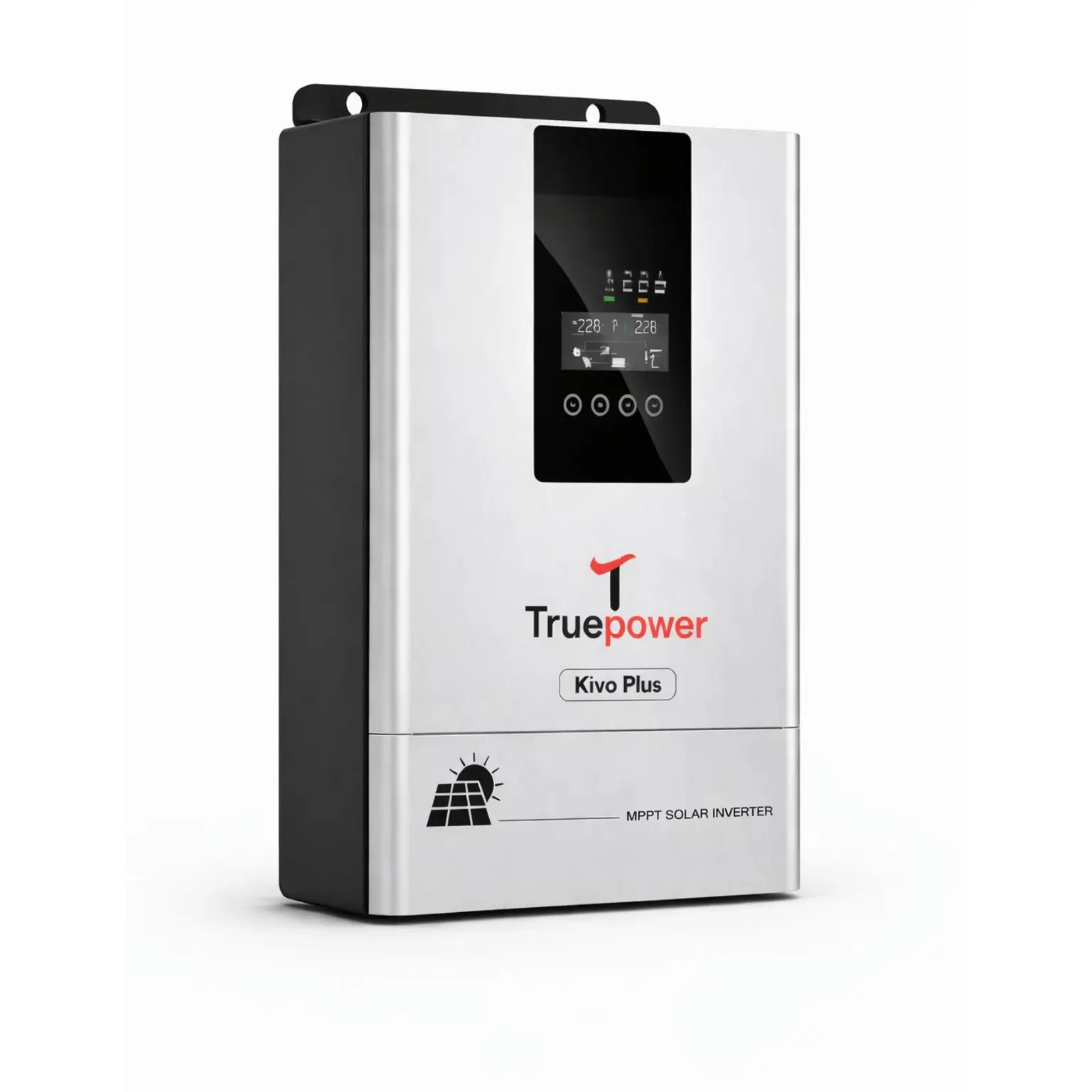
Kivo is the pick for homes, offices and shops that want solar and power-cut backup from one unit.
What you get
Kivo uses solar power first, then the battery, then the grid, and it exports surplus power for net metering. You choose the battery, lithium or lead-acid, and add it separately.
- Four models, 3.6 kW to 12 kW of load, at 24V or 48V
- Built-in MPPT charger supporting up to 5,000 W of panels on Kivo Plus, 9,000 W on Kivo Pro and Kivo Max, and 15,000 W on Kivo Ultra
- Warranty of 5 years
- BIS certified
Truepower’s hybrid range is also built for Indian voltage swings and long outages, with IP54 protection and parallel operation for heavy loads.
Who it suits and price
Kivo suits homes with long outages and bigger loads such as an air conditioner or a water pump. It also suits owners who plan to add panels later. A registered solar EPC installer should fit it, not a general electrician. Register the warranty through the Help Centre with your invoice and serial number.
Send your appliance list and backup hours to Truepower and we will suggest a model and battery. For a small flat without a solar requirement, we suggest Lithvon All-in-one ESS with in-built lithium battery system for a complete integrated solution.
Kivo is the pick when one unit must manage panels, battery and grid together.
4. UTL F-series on-grid solar inverter
The F-series is the pick for homes with a steady grid supply that want the lowest electricity bill.
What you get
An on-grid inverter needs no battery, so the system is simple and cheap. It feeds daytime solar into your home and sends the excess to the grid under net metering.
- F1 single-phase from 1.5 kW to 6.2 kW, F3 three-phase from 5 kW to 136 kW
- 10-year on-site warranty and BIS certification
- MPPT efficiency up to 99% and low harmonic distortion (THDi under 3%)
- WiFi monitoring through the UTL Solar App and power export limiting
Who it suits and price
It suits homes, offices and shops with a reliable supply, where most use falls between morning and evening. It gives you no backup, so a power cut means no solar power either. You also need your electricity company’s net metering approval, and the PM Surya Ghar subsidy depends on the eligible components and process, so confirm it with your installer.
UTL’s store lists the 3.3 kW model at ₹21,050. That is the lowest price per kW in this list.
An on-grid inverter saves the most money in daylight and gives you nothing in a blackout.
5. Luminous NXG solar inverter range
The NXG range is the pick for the tightest budgets and the smallest loads.
What you get
Luminous lists these as solar inverters with pure sine wave output and a 36-month warranty across the range.
- NXG 850e, 500 VA, ₹6,299
- NXG 1150e, 850 VA, ₹7,999
- NXG 1450e, 1100 VA, ₹9,699
- NXG 1850e, 1500 VA, ₹11,399
- NXG 2350, 2000 VA, ₹14,499
Who it suits and price
NXG suits small homes and rentals that want cheap backup with a few panels attached. Before you buy panels, confirm on the datasheet the maximum panel input and whether the controller is PWM or MPPT.
Prices start at ₹6,299 and reach ₹14,499 for 2000 VA. These are also the lowest figures in this article, and the trade-off is a shorter warranty than UTL’s on-grid or Truepower’s hybrid models.
The NXG range is the lowest entry cost, so check its panel limits before you size your array.
How to size a solar inverter for your home
Size the inverter to your running load plus headroom, then check that its panel input and battery voltage fit your plan.
Add up your load
List what must run during a cut and add the running watts. Here is a typical home:
| Load | Running watts |
|---|---|
| 4 ceiling fans, 75 W each | 300 |
| 8 LED lights, 12 W each | 96 |
| Refrigerator | 250 |
| TV | 100 |
| Router and chargers | 100 |
| Total | 846 |
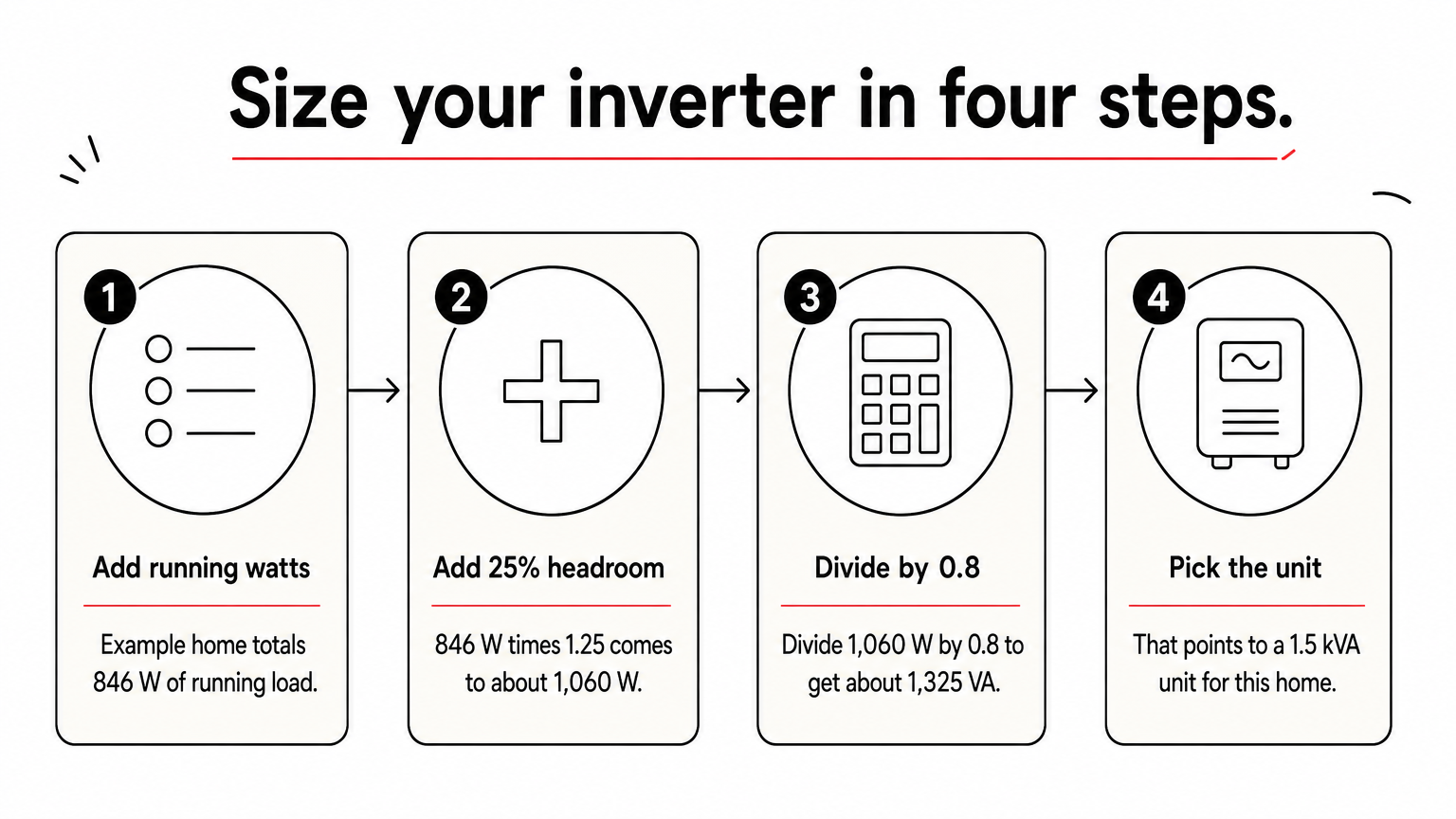
Add 25% headroom: 846 × 1.25 is about 1,060 W. A VA-rated inverter divides by a power factor of 0.8, so 1,060 ÷ 0.8 is about 1,325 VA, which means a 1.5 kVA unit. Add a 1.5-ton air conditioner at about 1,500 W and the load becomes 2,346 W, or about 2.9 kW with headroom. That points to a 3.6 kW hybrid such as Kivo. Air conditioners also draw a start-up surge, so ask the maker about surge capacity.
Match panels, battery and inverter
Check the inverter’s maximum panel input against your array. Kivo Plus takes up to 5,000 W, for instance. Higher ratings also use higher battery voltage: a 1 kVA unit typically runs on 12 V and a 3 kVA unit on 24 V, Deye hybrids take a 48 V battery bank, and Kivo comes in 24 V and 48 V models.
Backup time is roughly battery watt-hours divided by load watts, minus losses. A 2,560 Wh battery feeding the 846 W load above gives about three hours before conversion losses.
Checks before you buy
- BIS certification and the warranty terms, including how to register
- MPPT or PWM charge control, and which battery types are supported
- Installation by a qualified technician, since a wrong install can void the warranty
-
-
Net metering and PM Surya Ghar eligibility, confirmed before you pay
Common sizing mistakes
Four errors cost buyers the most money.
- Sizing to the label. A 2 kVA unit does not give 2,000 W of usable power. Multiply by the 0.8 power factor first, which leaves about 1,600 W.
- Ignoring start-up surge. A refrigerator, a water pump and an air conditioner draw several times their running watts for a moment when the motor starts. Ask the maker for the surge rating.
- Buying panels first. Panels above the inverter’s maximum input are wasted, and panels below it leave the battery half charged. Fix the inverter and its input limit, then choose the array.
- Mixing battery voltage. A 24 V inverter needs a 24 V bank, which means two 12 V batteries in series. Check this before you order batteries.
Also leave room to grow. If you may add an air conditioner or a second refrigerator within two years, buy one size up now. Replacing an inverter later costs more than the extra rating costs today.
-
Add your running watts, add 25% headroom, then pick the inverter that clears that number.
Solar power inverter price in India by type
Expect roughly ₹6,000 to ₹15,000 for small solar inverters, ₹20,000 to ₹70,000 for on-grid and mid-size hybrid units, and ₹73,000 and above for large hybrids.
Listed prices compared
| Type and model | Rating | Listed price |
|---|---|---|
| Entry solar inverter, Luminous NXG 850e | 500 VA | ₹6,299 |
| Entry solar inverter, Luminous NXG 1850e | 1500 VA | ₹11,399 |
| Entry solar inverter, Luminous NXG 2350 | 2000 VA | ₹14,499 |
| On-grid, UTL F-series | 3.3 kW | ₹21,050 |
| On-grid, Deye | 3 kW | ₹28,899 |
| On-grid, Deye SUN-5K-G05 | 5 kW | ₹37,999 |
| Hybrid, Truepower Kivo | 3.6 kW to 12 kW | Get the distributor price |
| Hybrid, Deye | 3.6 kW | ₹87,500 |
| Hybrid, Deye | 5 kW | ₹94,250 |
These come from the sellers’ own listings and shift with offers. Luminous’s full solar listing spans ₹5,999 to over ₹25 lakh, and the top end is commercial equipment.
What drives the price
Cost per kVA shows the pattern. You pay more as you add the grid-export hardware, lithium compatibility and longer warranties.
Remember that the inverter is only one line of the bill. Batteries, panels, mounting and installation come on top, so ask for a written quote that covers the full system. Check subsidy eligibility with your installer before you sign.
Look at the cost over the life of the system, not only on the day you buy. A longer warranty, such as the 10-year on-site cover on the UTL F-series or the 5-year cover on Kivo and Deye hybrids, spreads the repair risk over more years. A unit with a 3-year warranty may need replacing while your panels still have most of their life left. Batteries are the usual replacement cost, so ask which battery types the inverter supports and how many charge cycles the maker states.
Compare cost per kVA and warranty length, not just the sticker price.
Choosing the right solar inverter
Pick the type from your outage pattern, size it from your running load, and compare models on warranty, panel input and service. Hybrid fits most homes with cuts: Deye hybrids and Truepower Kivo hybrid for bigger loads such as an air conditioner, with Truepower offering smaller systems compatible with 24 V battery system. Deye on-grid and the UTL F-series fit a steady supply, and the UTL F-series gives the lowest price per kW. For budget backup in a small flat, Luminous NXG covers a few fans, lights and a router.
If you are a dealer, installer or distributor who wants to stock hybrid inverters like Kivo, you can get distributor prices from Truepower. Homeowners can send us an appliance list and backup hours, and we will suggest a model and battery.